
Discover our amateur to advance astronomical research projects from our club members
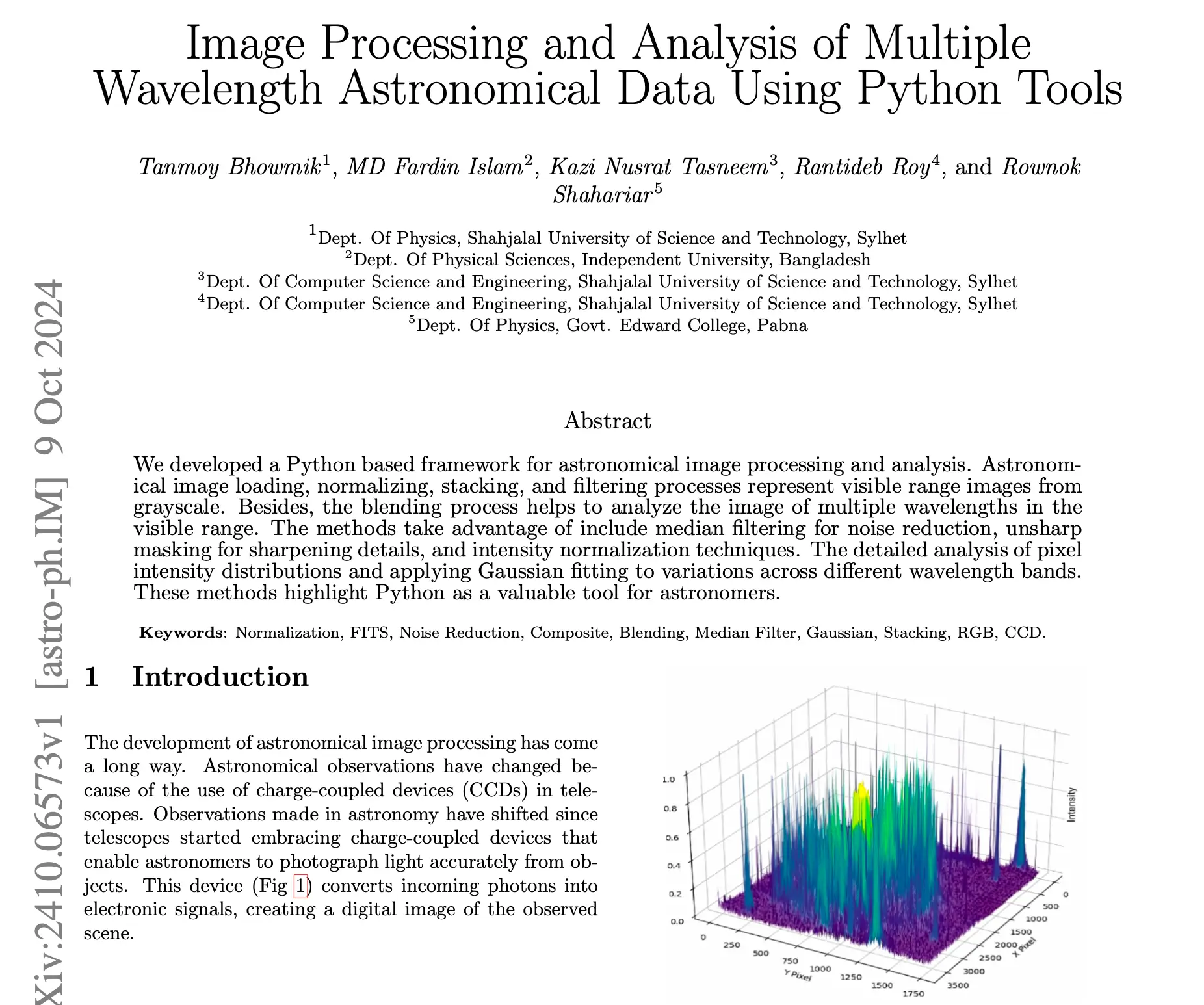
We developed a Python based framework for astronomical image processing and analysis. Astronomical image loading, normalizing, stacking, and filtering processes represent visible range images from grayscale. Besides, the blending process helps to analyze the image of multiple wavelengths in the visible range. The methods take advantage of include median filtering for noise reduction, unsharp masking for sharpening details, and intensity normalization techniques. The detailed analysis of pixel intensity distributions and applying Gaussian fitting to variations across different wavelength bands. These methods highlight Python as a valuable tool for astronomers.
The vast distance between objects in the universe can be directly calculated by observing it's spectra. The red-shift of the object due to the Hubble flow helps to find the relativistic distance (DS ) of the object. The cosmological parameters ΩM , Ωk and ΩΛ could be used to calculate the co-moving distance (DC ), the angular distance (DA) and the luminosity distance (DL). The focus of this report was to take spectra of four galaxies and calculate the relativistic distance by identifying the location of the Hα and Hβ lines. DC , DA and DL were calculated with cosmological parameters with ΩΛ = 0.6847 ±0.0073,ΩM = 0.3153 ± 0.0073,Ωk = 0.001 ±0.002 and the Hubble constant H0 = 72 (km/s)/MPc
Information about Active Galactic Nuclei (AGN's) mass can help to know more about the host galaxy's evolution. Using reverberation mapping, we can determine the 'primary' mass of the AGN. Here primary mass refers to the mass determined by motion of the nearby gas. In this study we retrieved spectral data of five Active Galactic Nuclei (AGN) to get these data. We fit two 2D Gaussian curves for a narrow line and a broad line region of the AGN spectra to determine the mass.
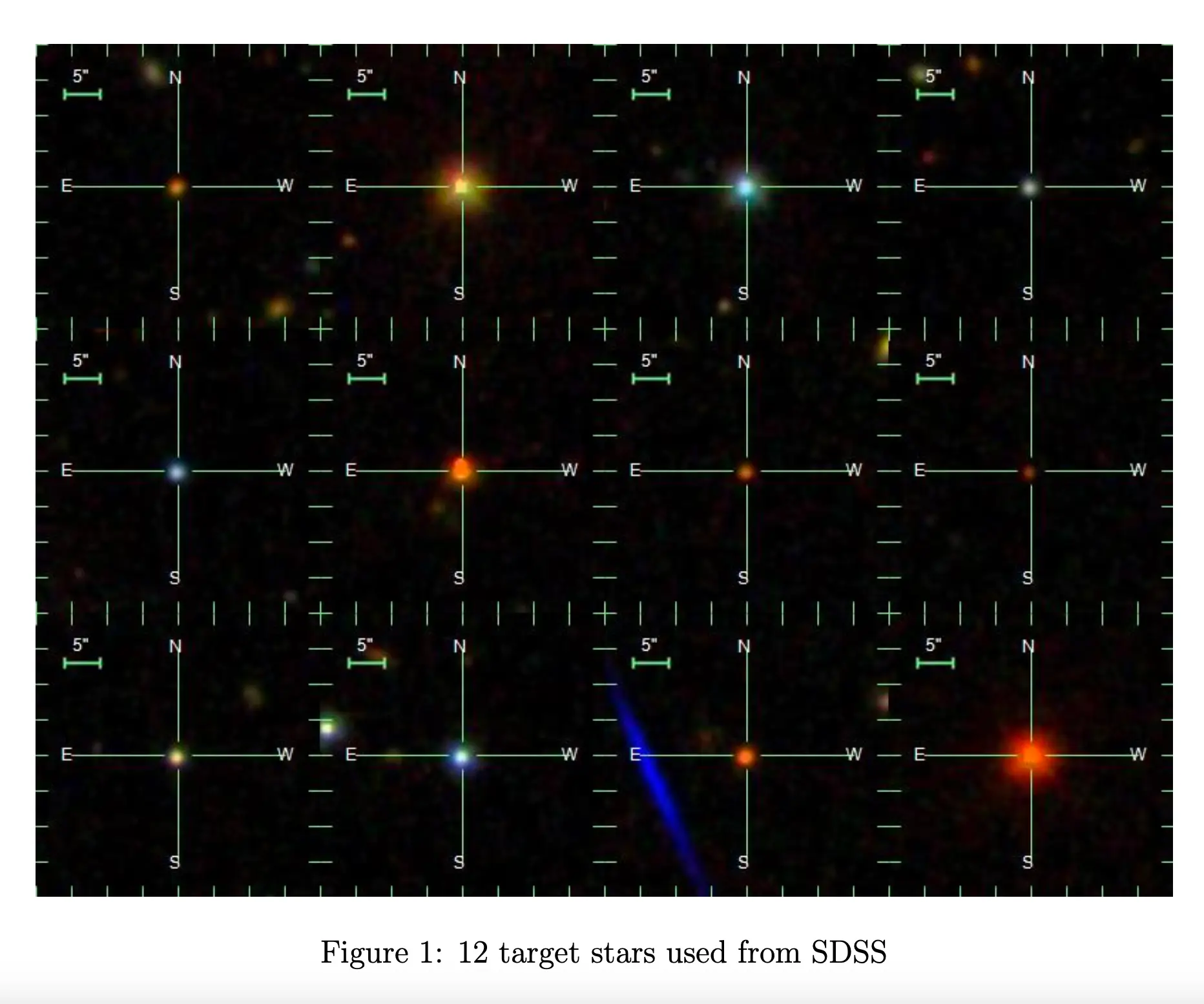
This project aims to understand different stages of star evolution by constructing a model Hertzsprung-Russell Diagram. In this study, twelve target stars were particularly selected and their data were collected from the publicly available database of SDSS and we used aperture photometry for our analysis. Our results showed that most of these stars are in the main sequence phase; therefore, they are very important in the star life cycle. We also considered the effectiveness of simple aperture photometry for this kind of analysis. Since our project had to be as simple and accessible as possible, we chose methods that are easy to understand and deliberately avoided complex analyses.